Australia’s Data Centre Boom: What It Means for Civil Infrastructure and Project Feasibility
Artificial intelligence is often discussed as software, algorithms and computing power. But behind every AI model sits something far more physical: land, substations, transmission infrastructure, water, roads, drainage, concrete, structures, utilities and a significant construction programme.
That physical footprint is becoming increasingly important as data centre construction in Australia accelerates.
The Australian Energy Market Operator (AEMO) now forecasts data centre electricity consumption in the National Electricity Market to increase from approximately 5 terawatt hours in 2025–26 to 34 terawatt hours by 2035–36. That represents an increase from around 3% to approximately 13% of electricity supplied through the grid. AEMO has also changed its forecasting methodology to better reflect the rapidly developing data centre sector.
There are now reportedly 225 data centre projects at various stages of development seeking connection to the National Electricity Market, more than double the number identified a year earlier.
For developers, investors and contractors, the growth of AI infrastructure in Australia represents a significant opportunity. But it also raises an increasingly important question:
Can the supporting infrastructure keep pace with the demand?
AI Infrastructure Is Also Civil Infrastructure
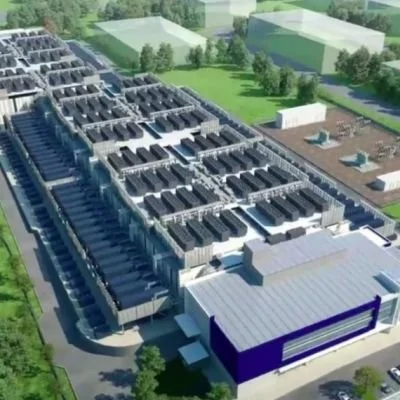
It is easy to think of a data centre as primarily a building containing servers.
In reality, the feasibility of a major data centre can depend just as heavily on what happens outside the building.
A large-scale facility may require substantial enabling works, including:
bulk earthworks and site preparation
access roads and heavy vehicle movements
stormwater and drainage infrastructure
electrical substations and transmission connections
underground services and service corridors
water supply and cooling infrastructure
wastewater systems
retaining structures
concrete foundations and equipment pads
security infrastructure and fencing
backup generation and energy storage
landscaping, acoustic treatments and environmental controls.
For major AI data centres, power capacity in particular can become one of the defining constraints on location, staging and programme.
This means data centre project feasibility can no longer be considered solely in terms of land value, planning controls and building cost. The availability, capacity and cost of the surrounding civil and utility infrastructure must form part of the decision from the beginning.
Power Is Becoming a Project Development Issue
Australia's rapidly growing AI sector is creating an entirely new category of major electricity demand.
Infrastructure Australia notes that data centres are becoming a significant standalone component of energy demand because of the electricity required to operate and cool computing equipment. It also notes that faster AI uptake could accelerate data centre energy consumption beyond current forecasts.
The Federal Government's approach is consequently changing.
In July 2026, the Australian Government announced plans for national AI standards that would require large data centres to contribute more directly to their own energy requirements, including obligations relating to new power supply, grid connection costs, energy efficiency and water use.
Then, at National Cabinet on 26 August 2026, the Commonwealth, states and territories agreed to work towards nationally consistent mandatory standards for large data centres covering energy, water and land use, with Commonwealth legislation intended for early 2027.
For project developers, this changes the feasibility equation.
Power can no longer be treated as a service connection to be resolved after the site and concept have largely been determined.
It may influence:
where the project is located, how large it can become, how it is staged, what supporting infrastructure is required and ultimately whether the development is commercially viable.
Water Is the Other Constraint That Cannot Be Ignored
High-density computing produces considerable heat, making cooling a critical component of data centre design.
The Australint expectations for data centres specifically call for efficient and sustainable water use, early engagement with water utilities, consideration of local water availability and greatean Government's currer use of non-potable and circular water solutions where practical. Developers are also expected to account for their share of additional infrastructure costs.
This creates another important Project Development consideration.
A site may appear attractive based on planning, land and electricity access, but become substantially less attractive once the cost of water infrastructure, additional utility upgrades, treatment, storage or alternative cooling systems is considered.
Early data centre feasibility studies should therefore examine water and power together rather than treating them as separate downstream design packages.
Site Selection Will Become More Complex
The traditional development approach of securing land first and solving infrastructure later carries greater risk for projects of this scale.
The Federal Government has made it clear that future large data centres will need to be appropriately located, with consideration given to energy infrastructure, water security, land use and surrounding communities. National Cabinet has now agreed that these matters should form part of the emerging national framework.
For developers, effective site selection should consider more than available hectares.
A robust assessment should examine:
power availability and connection strategy
proximity to transmission infrastructure
water availability
existing utility capacity
geotechnical conditions
bulk earthworks requirements
flooding and drainage
road and heavy vehicle access
surrounding land uses
environmental approvals
community interfaces
planning constraints
construction workforce availability
supply chain access
programme and procurement risk.
Understanding these constraints early allows different sites and development options to be compared on a true whole-of-project basis, rather than simply comparing land acquisition costs.
The Importance of Early Cost Planning
The speed of growth in data centre construction can create pressure to move projects quickly from opportunity to design.
But speed without sufficient early definition can transfer significant risk into the construction phase.
Before major capital commitments are made, developers need a defensible view of the project's likely cost and delivery requirements.
For data centre construction in Australia, early cost planning should extend beyond the primary building and include the enabling infrastructure necessary to make the facility operational.
A robust Basis of Estimate should consider quantities, methodology, programme, site constraints, utility upgrades, temporary works, market capacity, procurement strategy, escalation, risk and project-specific assumptions.
This is where first-principles estimating becomes particularly valuable.
Benchmark rates can help during early optioneering, but two apparently similar data centre sites can have very different development costs once power connections, earthworks, water infrastructure, access and environmental requirements are properly assessed.
Constructability Should Start Before Construction
The most valuable time to resolve a construction problem is before it reaches site.
Early constructability reviews can identify whether the proposed development can actually be delivered within the intended programme and budget.
For a major data centre, that might involve reviewing:
construction access and logistics
bulk excavation and material movements
crane and heavy lift requirements
underground utility congestion
sequencing of substations and electrical infrastructure
temporary power requirements
long-lead equipment
staged commissioning
workforce requirements
interaction between building, civil and services packages.
These reviews can also identify opportunities for value engineering, modularisation, alternative staging, procurement packaging and programme optimisation.
The objective is not simply to reduce capital cost. It is to develop a solution that delivers the required performance with an appropriate balance of cost, programme, risk and constructability.
AI May Be Digital, but Its Growth Depends on Physical Infrastructure
Australia has an opportunity to become an important destination for global data centre and AI investment.
The Australian Government's Data Centre Expectations already identify data centres as important infrastructure supporting digital services, scientific research, economic activity and AI capability, while acknowledging that future development must also support the energy transition, water security, jobs and local communities.
The next phase of growth will therefore require more than technology investment.
It will require coordinated investment in civil infrastructure, energy, water, transport and utilities.
For developers considering new AI and data centre projects, the strongest projects will be those that test these issues early.
Before progressing from opportunity to investment, key questions should include:
Is the site genuinely suitable?
Can the required power and water be secured?
What enabling infrastructure will be required?
What will the complete development cost?
Can it be built within the proposed programme?
Where are the major risks and opportunities?
Answering those questions early is the foundation of good project development.
As Australia's data centre construction pipeline expands, effective feasibility analysis, constructability, cost planning, optioneering and infrastructure strategy will increasingly determine which projects successfully move from concept to construction.